When he was chosen, he served.
When he was no longer needed, he placed his leadership back into the arms of a republic.
When he was asked to lead again, he did.
When he was handed a Constitution, he studied it to clarify the role that he had been given, not one that he would make for himself. His notes in the margins give us clues about his questions and thoughts.
He thought continually, and in detail, about his example to the people around him and to the nation as a whole.
His last will and testament called for the emancipation of his slaves —over 120 of them. He wanted the people to know that he had logically concluded slavery would not work in theory nor in practice in the kind of nation he had helped to found. At the time of his death, his will was made public and reproduced as pamphlets. George Washington’s PR machine was still in operation. In fact, George Washington gave great thought to the permanence of his legacy. His example will outlive us all.
And with that, we look at a statue.
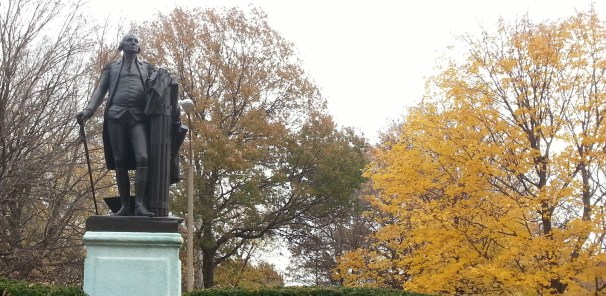
The statue in the photograph is a copy of the well-known Houdon statue — the original standing in the Virginia state house in Richmond. According to experts, it is one of approximately 33 copies known to exist. This one stands in Lafayette Square Park in St. Louis, MO. Judging by the dog to human ratio in Lafayette Park, it’s possible that more dogs see this than Americans. Fortunately, Washington is high enough off the ground to not solicit their “unwanted attention.”
Also, according to experts, it is likely to be the closest representation of George Washington that exists. Houdon, at the request of Thomas Jefferson, traveled from France to stay with Washington. He measured Washington’s every detail, made a life mask, walked with him and observed him. He was a perfectionist, as author Ron Chernow remarks, much like Washington himself. Washington gave him very little instruction on how he wished to appear.
In one detail, however, Washington had his say. “With true humility,” says Chernow, “Washington had asked to have the sculpture life-size instead of larger than life, and Houdon had heeded this noble request.”
And so we have another of Washington’s examples for our lives. The size of the statue, seemingly insignificant to those who may visit it, makes a tremendous statement. “I was…a man.”
When visiting the Lincoln Memorial in Washington, D.C. several years ago, I remember thinking to myself, “I doubt this is what Lincoln would have wanted.”
A far more apt display would have been, in my opinion, a life-sized A. Lincoln (tall enough in his own right), leading hundreds of people up Pennsylvania Avenue. There would be run-of-the-mill mothers, fathers and children. There would be soldiers from the Union and the Confederate armies. There would be emancipated slaves, immigrants, farmers and factory workers. They would all be in bronze. It would be a man — the man — leading people. That message would say to the school child that greatness doesn’t lie within the icon, but it lies within the heart of a person who chooses to lead through adversity.
Unfortunately, Lincoln had to leave his posterity in the hands of others. Washington lived long enough to give attention to his posterity.
Though they were in many ways far different from one another, Washington and Lincoln shared this one trait: they both knew that they had to lead by example.
For more information on the original Houdon statue of Washington, visit:
https://www.history.org/Foundation/journal/Autumn03/houdon.cfm
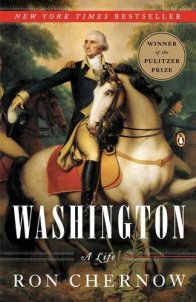
For an excellent one-volume life of George Washington, I would suggest Ron Chernow’s Washington: A Life.